
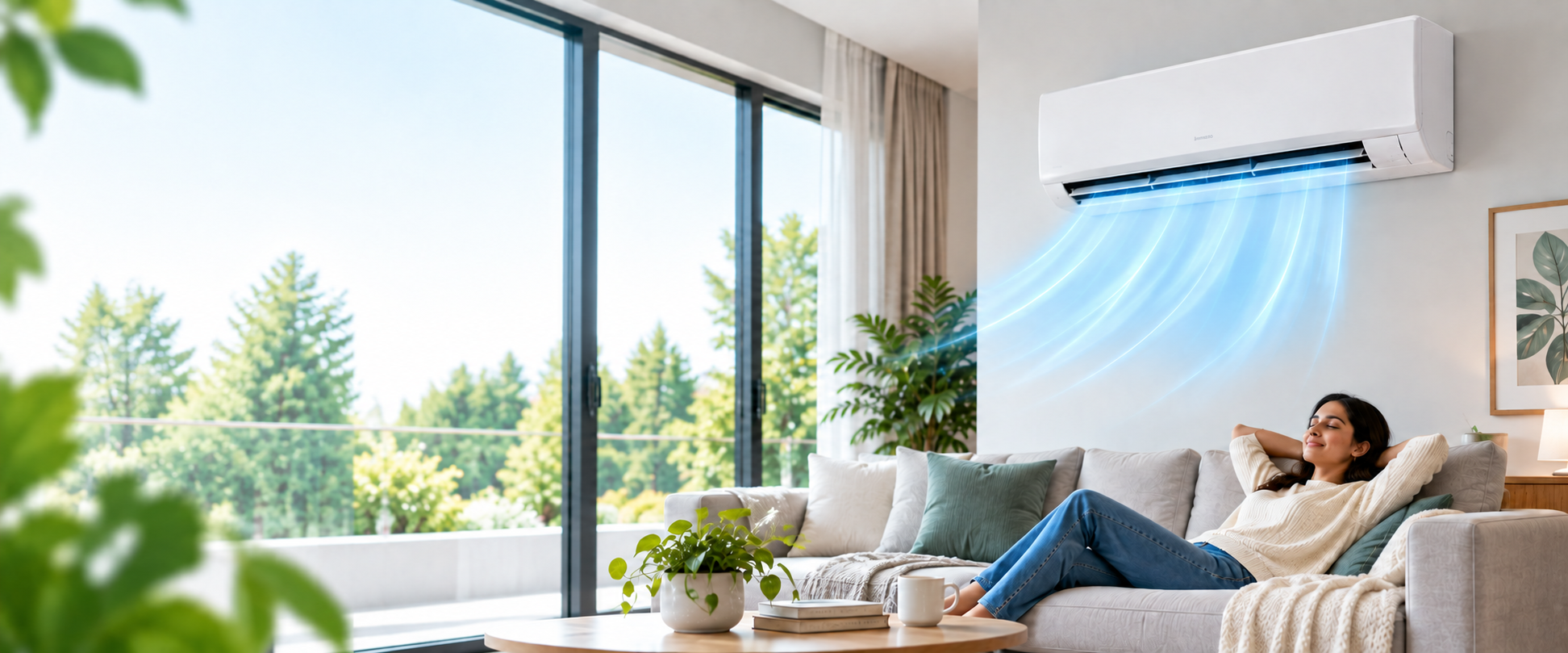
Split System Air Conditioning Installation Melbourne
One room, one reverse cycle unit, usually installed in a single day.
A split system is the simplest and most affordable way to heat and cool a single room. Smart Solar Energy installs reverse cycle split systems across Melbourne, within 50 kilometres of our Glen Waverley base — and because we also install solar, we can size the unit to run on your own daytime generation.
How a split system works
A split system has two parts, which is where the name comes from. The indoor unit sits high on a wall inside the room and blows conditioned air across it. The outdoor unit holds the compressor and sits outside, usually against the same wall or on a bracket. The two are connected by refrigerant pipework, a drain line and an electrical cable running through a small hole in the wall.
Every split system we install is reverse cycle, so the same unit cools in summer and heats in winter. In Melbourne, where most households use their air conditioner more for heating than cooling, that matters more than anything else about the unit.
The cheapest way to heat a living room
A reverse cycle split moves heat rather than generating it, which makes it several times more efficient than a plug-in or panel heater. For a household that mostly heats one living area, a single well-sized split is often cheaper to run than a whole-home system heating rooms nobody is in.
Where the units go
Placement decides how well the system performs and how much the install costs. We work it out on site rather than guessing from a floor plan.
Indoor unit
High on a wall with clear airflow across the room, away from direct sun, and ideally on an external wall so the pipe run stays short.
Outdoor unit
Shaded where possible, with room to breathe on all sides, and positioned away from bedroom windows and neighbours' living areas to keep noise down.
Pipe run
The shorter the distance between the two units, the simpler and cheaper the install. Longer runs go through the roof space or a wall cavity.
Back-to-back or extended run
A back-to-back install puts the indoor and outdoor units on opposite sides of the same external wall. It is the quickest and most affordable setup. Where the room has no suitable external wall, or the outdoor unit needs to go somewhere else, the pipework runs further through the roof or a cavity, which adds material and labour. Both are common, and the quote reflects which one your room needs.
What size split system do you need?
Capacity is matched to the room, not guessed from the floor area alone. Ceiling height, insulation and window orientation all change the answer.
West-facing glass, high ceilings and poor insulation all push the required capacity up. An undersized unit runs flat out and still struggles; an oversized one cycles on and off and leaves the air clammy.
Split, multi split or ducted?
A split system is the right choice for most single rooms, but not every home. Here is how the three compare.
If you want two or three rooms covered, several splits or a multi split usually cost less than ducting. If you want the whole house, see all air conditioning options.
Running a split system on solar
Split systems pair well with solar because a single unit draws a modest amount of power, often well within what a typical array produces through the middle of the day.
Getting the most from your solar
- Cool the room through the afternoon while the panels are producing, rather than waiting until evening
- Pre-heat on winter afternoons so the room is already warm when generation drops off
- Use the unit's timer or app to shift running time into daylight hours
- If you heat mostly at night, battery storage carries daytime generation into the evening
Exporting surplus solar earns around three cents per kilowatt hour in Victoria now. Running your split system on it instead avoids paying roughly thirty-two cents for the same power from the grid. See solar panels Melbourne if you do not have solar yet.
Brands we install
We install split systems from manufacturers with established Australian service networks, so warranty claims are handled locally.
Installation day
Indoor and outdoor locations are confirmed with you before anything is drilled.
The indoor bracket goes up, a hole is cut for the pipework, and the outdoor unit is set on a bracket or pad.
Refrigerant lines, drain and power are connected, and the penetration is sealed and weatherproofed.
The system is pressure tested, charged and run through heating and cooling. You are shown the controls before we leave.
Areas we service
Frequently asked questions
Sizing, placement, heating and installation.
How long does a split system installation take?
Most single split systems are installed in a day, particularly back-to-back installs where the indoor and outdoor units sit on opposite sides of the same wall. Longer pipe runs through the roof or a cavity can take a little longer.
Is a split system good for heating in winter?
Yes. Reverse cycle split systems are among the most efficient ways to heat a room, because they move heat rather than generate it. They are several times more efficient than plug-in or panel heaters and work well through a Melbourne winter.
What size split system do I need?
A bedroom usually needs 2.5 kW, a larger bedroom or small lounge 3.5 kW, and an open living area 5 to 7 kW. Ceiling height, insulation and west-facing windows can push that up, which is why we confirm the size on site.
Can I put a split system in a room without an external wall?
Usually yes. The pipework can run through the roof space or a wall cavity to reach the outdoor unit. It adds some material and labour compared with a back-to-back install, and we cover it in the fixed quote.
Is one split system cheaper to run than ducted?
For a single room, almost always. A split heats or cools only the space you are in, while ducted conditions the whole house unless it is zoned. If you mostly use one living area, a split is usually the cheaper option to run.
Can a split system run on solar?
Yes. A single split draws modest power, often well within what a typical solar array produces through the day. Running it during daylight hours uses your own generation rather than grid power. For evening use, a battery helps.
Tell us which room you want covered and we'll size the unit and send a fixed installed price.
Request a free quote