
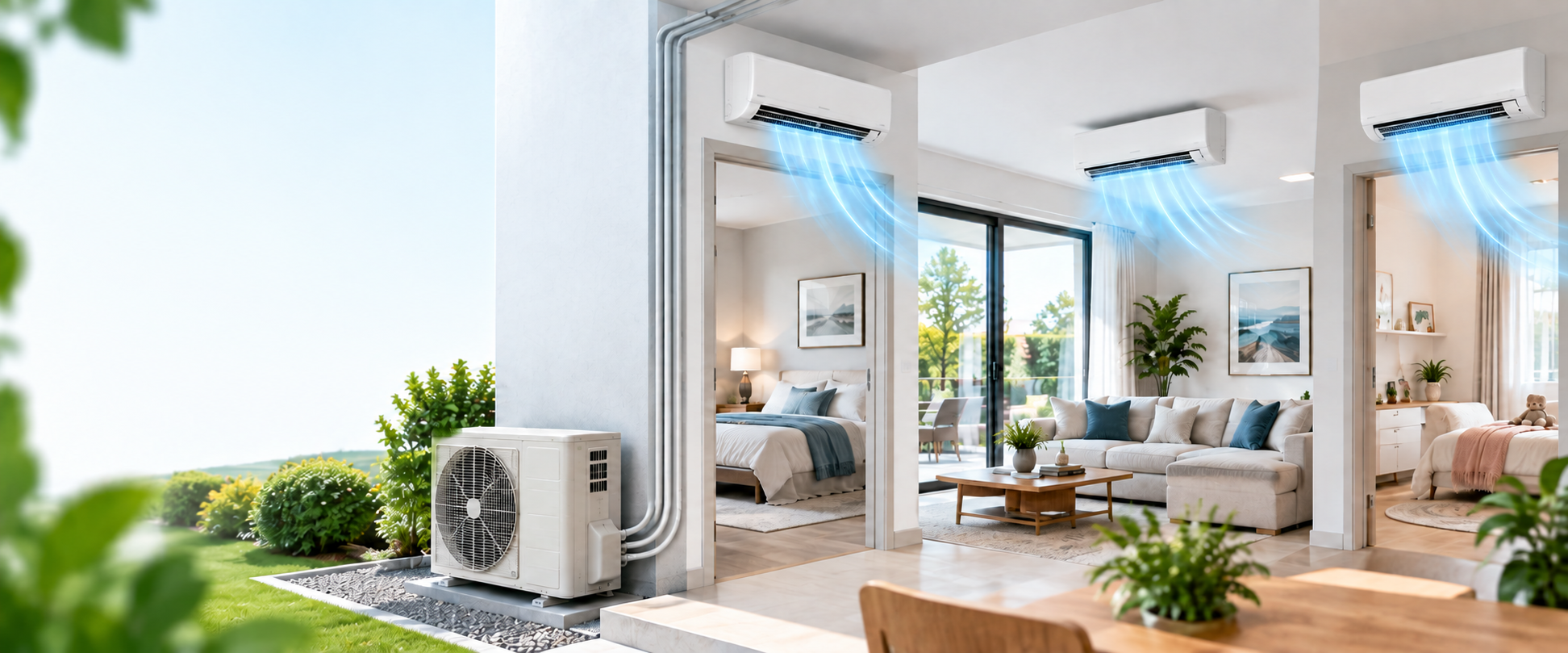
Multi Head Air Conditioning Installation Melbourne
Several rooms, one outdoor unit, and no ductwork through the roof.
A multi head system runs several indoor units from a single outdoor unit, so you can heat and cool three or four rooms without a row of compressors along the side of the house. Smart Solar Energy installs reverse cycle multi head systems across Melbourne, within 50 kilometres of our Glen Waverley base.
How a multi head system works
A standard split system pairs one indoor unit with one outdoor unit. A multi head connects two to five indoor units to a single, larger outdoor unit. Each indoor unit has its own refrigerant line back to the outdoor unit and its own controller, so every room can be set to a different temperature or switched off entirely.
It sits between a single split system and ducted. You get independent control in several rooms like ducted, without needing roof space for ductwork, and with far fewer outdoor units than fitting a separate split in every room.
Who multi head suits
Townhouses and units
Limited courtyard or balcony space makes one outdoor unit far easier to place than three or four.
Homes without roof space
Flat roofs, tight cavities or cathedral ceilings that rule out ducted can still take a multi head.
Strata properties
Many owners corporations limit how many outdoor units can go on a building. A multi head needs only one.
Renovations
Adding cooling to several rooms without opening ceilings or running ductwork through a finished house.
The trade-off worth knowing
Because every indoor unit relies on one outdoor unit, a fault there takes every room offline at once. With separate split systems, one failure affects one room. For most households the space and appearance benefits outweigh this, but it is worth weighing if cooling a particular room is critical — a home office in summer, for example.
Multi head, split or ducted?
For a single room, a split system is simpler. For the whole house with roof space available, ducted usually makes more sense. Multi head fills the gap in between.
Indoor unit styles
Each room can take a different style of indoor unit, all running off the same outdoor unit.
Wall mounted
The most common choice. High on the wall, efficient, and the simplest to install.
Floor console
Sits low on the wall. Good for heating, since warm air rises from floor level, and for rooms with limited wall height.
Ceiling cassette
Set into the ceiling with airflow in several directions. Suits larger open rooms.
Sizing a multi head system
Each indoor unit is sized to its room, then the outdoor unit is sized to cover them. The outdoor unit does not have to equal the total of every indoor unit, because rooms are rarely all running at full output at the same time.
These are starting points. Every room is assessed for size, insulation and sun exposure, and the combination is checked against the outdoor unit's rated capacity on site.
Running multi head on solar
Planning with your solar
- Cooling living areas through the afternoon lines up well with solar generation
- Switching off unused rooms keeps the total draw within what the panels produce
- Bedroom heating mostly runs in the evening, where battery storage helps
- The switchboard is assessed once for both, rather than by two separate trades
Export earns around three cents per kilowatt hour in Victoria now, while buying the same power back costs about thirty-two. Running several rooms on your own daytime generation closes a lot of that gap.
Brands we install
How installation works
Each room is measured, indoor unit positions are agreed, and the outdoor location and pipe routes are checked.
Indoor units sized per room, outdoor unit matched to the combination, all priced together.
Usually one to two days, depending on how many rooms and how far each pipe run travels.
Every indoor unit is tested in heating and cooling, controllers are set up, and paperwork is handed over.
Areas we service
Frequently asked questions
How it works, sizing, strata and running costs.
How many rooms can a multi head system cover?
Most multi head systems run two to five indoor units from one outdoor unit. The exact number depends on the outdoor unit's capacity and the size of each room, which we work out on site.
Is multi head better than several split systems?
It depends on what matters more. Multi head needs only one outdoor unit, which suits townhouses, units and strata properties. Separate splits cost a little less and keep rooms independent, so one fault only affects one room.
What happens if the outdoor unit breaks down?
Every room connected to it stops working until it is repaired. That is the main trade-off with multi head, and worth considering if one room absolutely must stay cool, such as a home office through summer.
Can I have different indoor units in different rooms?
Yes. Wall mounted, floor console and ceiling cassette units can run off the same outdoor unit, so each room gets the style that suits it.
Is multi head good for apartments and townhouses?
Often it is the best fit. Limited balcony or courtyard space, and owners corporation rules on outdoor units, make one outdoor unit far easier than three or four. Check your body corporate rules before quoting.
How long does multi head installation take?
Usually one to two days, depending on the number of indoor units and how far each pipe run has to travel back to the outdoor unit.
Tell us which rooms you want covered. We will size each unit and send a fixed installed price.
Request a free quote